SEO
CRISP
How We Built crisp.you as the Product-Led SEO Home for CRISP Content Engine
Content Marketing
Next.js
Content Driven SEO For SaaS Products
For a while, CRISP Content Engine lived inside the CrisP Digital ecosystem. That made sense at the beginning because the product came directly from the same work we do with clients, building digital marketing systems, improving content workflows and helping businesses turn scattered ideas into more consistent execution.
But as the product became more defined, the customer journey needed a cleaner structure.
A person discovering CRISP Content Engine should not have to work out whether they are on an agency page, a product page or an app page. They should be able to understand the product quickly, explore pricing, read use cases, learn from useful articles and start free without friction.
That is why we built crisp.you as the dedicated product-led SEO home for CRISP Content Engine.
The product needed its own front door
A product website has a different job from an agency website.
CrisP Digital exists to explain our consulting, strategy and marketing implementation work. CRISP Content Engine exists to help users build a content system they can use directly. Those two things are connected, but they should not compete for the same job.
The new structure gives each surface a clear role.
Surface | Role |
|---|---|
crisp.you | The public product website, SEO hub, pricing page, use cases, feature pages and blog |
app.crispdigital.io | The product app, onboarding, billing and user workspace |
crispdigital.io/crisp-content-engine | The CrisP Digital bridge page explaining the product’s origin and pointing to crisp.you |
abl.international | The corporate layer for company ownership and project announcements |
This is simple, and that is the point. When every URL has a job, the journey becomes easier for users and easier for search engines to understand.
The strategy behind crisp.you
The site was built around one central idea.
Consistent visibility works best when content is treated as a system.
That is also the product idea behind CRISP Content Engine.
Most businesses do not need more random content ideas. They need a practical way to connect their brand, audience, offer, content queue, review process and publishing rhythm. Without that structure, content usually depends on spare time and the energy to start again every week.
CRISP Content Engine is designed to change that workflow.
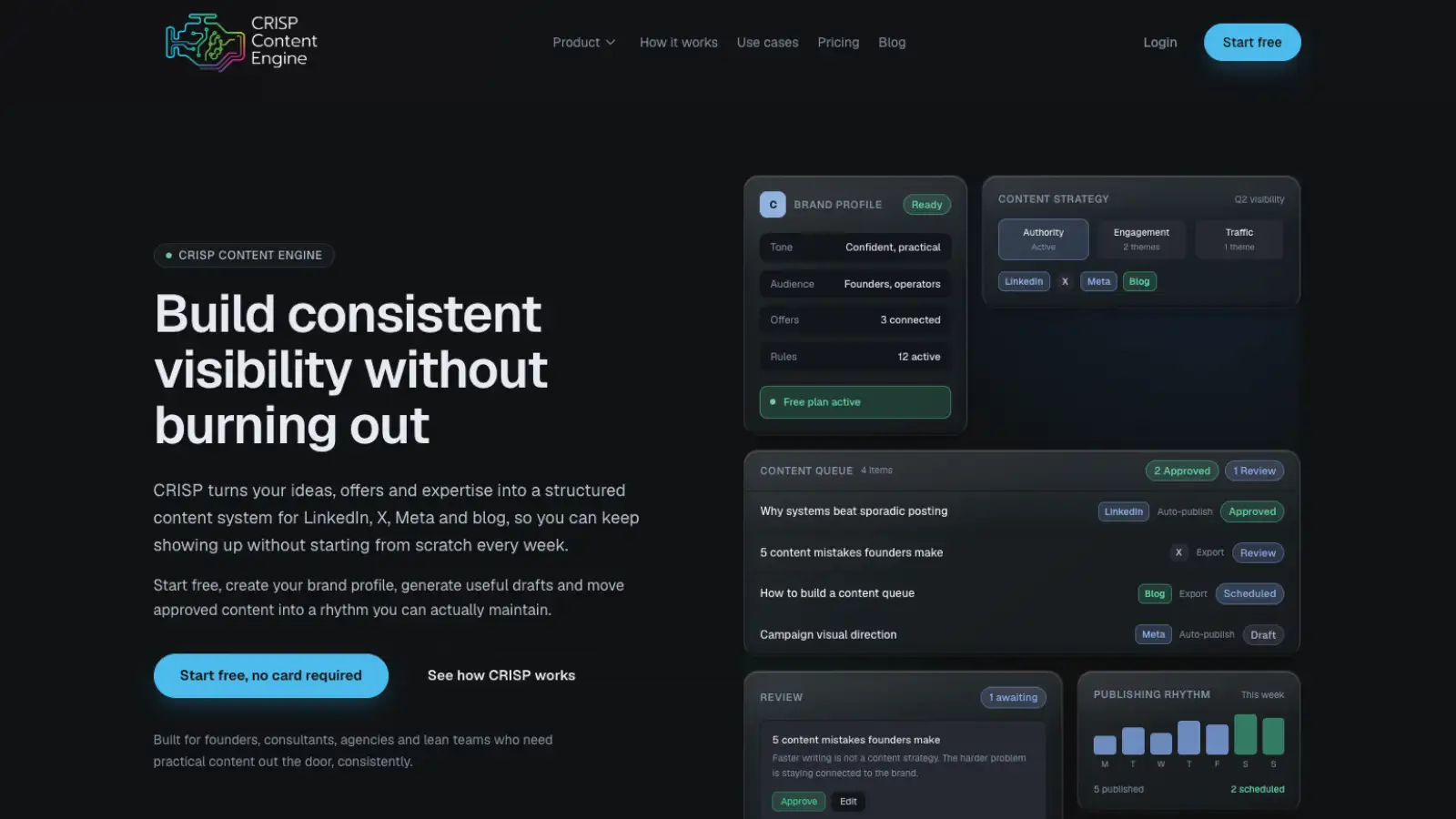
The product helps users create a brand profile, generate content from context, review drafts and move approved work into export or supported publishing paths across LinkedIn, X, Meta and blog.
The website had to communicate the same logic.
So crisp.you was structured around the way a user actually evaluates the product.
They need to know what it is, who it is for, how it works, what it costs and whether it solves a real problem they recognise. They also need useful content that helps them understand the category, not only the product.
That shaped the full site architecture.
The site architecture
The homepage introduces the product as a content system for people who cannot keep starting from scratch. It leads with the practical promise behind the product, helping founders, consultants and lean teams build consistent visibility without burning out.
The pricing page explains the free Starter plan and paid plans clearly, using the live product billing structure as the source of truth. This matters because pricing drift creates trust issues quickly. If the marketing site says one thing and the app says another, users notice.
The use case pages give different audiences their own path into the product.
Founders need visibility while running the business. Consultants need thought leadership that supports authority. Lean teams need a shared workflow. Agencies and operators need multi-brand structure.
The feature pages explain the parts of the system that make CRISP different. Brand profiles, content queues, LinkedIn workflows and AI image prompts are all treated as part of a connected operating layer, rather than as isolated feature claims.
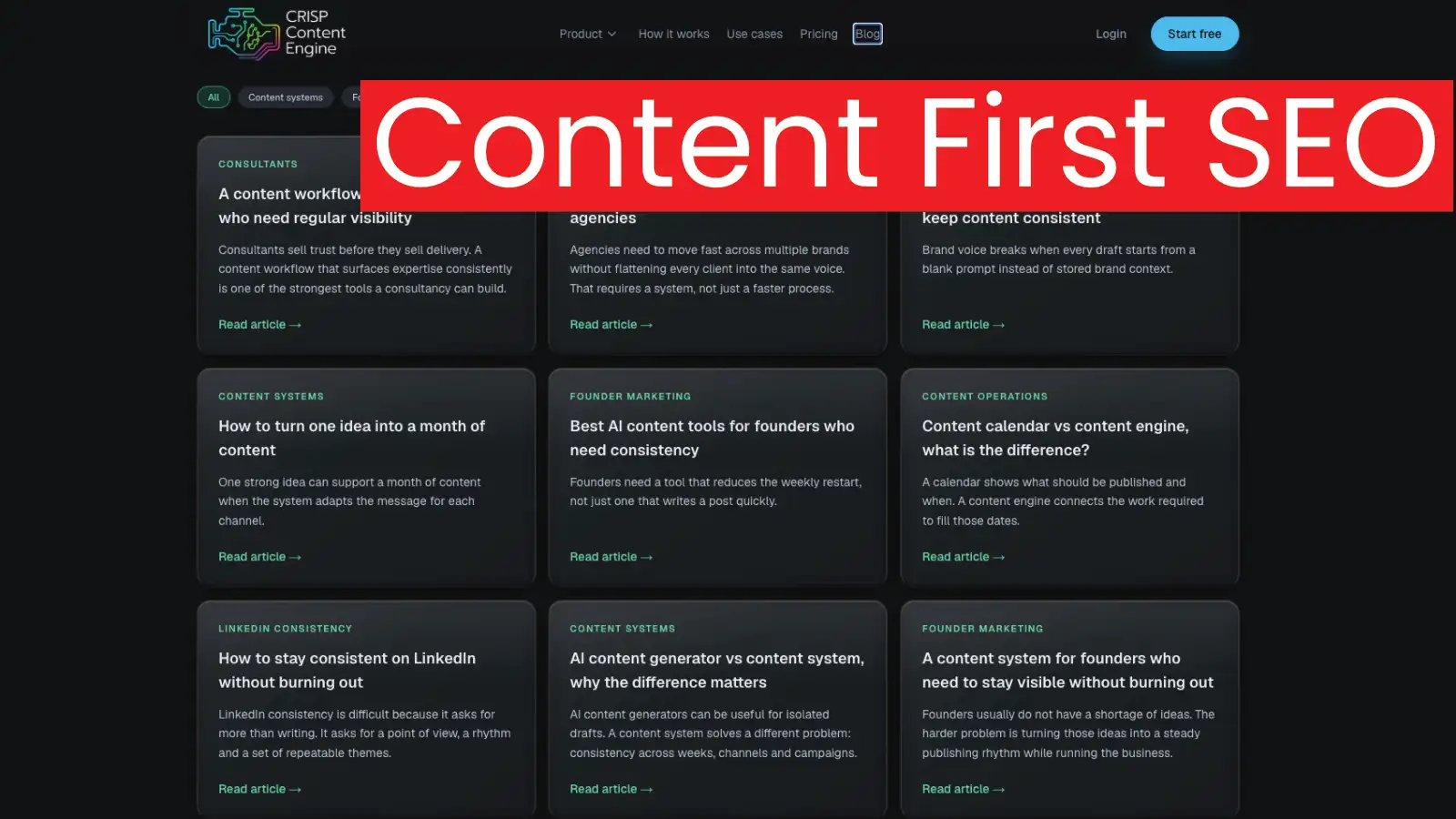
The blog creates the SEO foundation around the category. Read the content systems blog.
Articles cover topics such as how to build a content system, the difference between a content calendar and a content engine, how to stay consistent on LinkedIn, AI content with brand voice and how to turn one idea into a month of content.
This gives Google, LLMs and human visitors a clearer understanding of what CRISP Content Engine is trying to own.
SEO built around product clarity
The SEO approach for crisp.you is deliberately practical.
The goal is not to publish a large volume of thin articles and hope something ranks. The goal is to build a coherent product knowledge base around the exact problems CRISP Content Engine solves.
That means the site targets topics such as:
Topic | Why it matters |
|---|---|
Content system | The category CRISP is designed to define and own |
Founder content | A core use case and strong buyer segment |
LinkedIn consistency | A real pain point for founders and consultants |
AI content with brand voice | A common concern around AI-assisted content |
Content queue | A workflow concept that explains the product |
Content calendar vs content engine | A useful comparison that shows why CRISP is more than planning |
Multi-brand content management | A Pro and Scale use case for agencies and operators |
The site also includes the technical pieces needed for discovery.
It has a sitemap, robots file, canonical URLs, structured metadata, local legal pages and an llms.txt file that gives AI systems a concise map of the product, key pages and articles.
The key word is connected.
The content, metadata, internal links, footer, sitemap and product pages all need to tell the same story. That is how a product site starts to become understandable, both to users and to search systems.
Why llms.txt was added
AI search and answer engines need context. They work best when a product gives them clean, structured information about what it is, who it is for and which pages matter.
The llms.txt file gives CRISP Content Engine a clear reference point. It summarises the product, audience, pricing, core pages, comparison pages and main articles in a format that language models can read easily.
This does not replace traditional SEO. It supports it.
Search still needs crawlable pages, strong headings, useful content, internal links, schema and a coherent sitemap. The llms.txt file adds another structured layer for the way discovery is changing.
The bridge page on CrisP Digital
The existing CrisP Digital page for CRISP Content Engine was not removed. It was repositioned.
That page now has a clearer role as a bridge from CrisP Digital to the dedicated CRISP Content Engine site. It explains that the product was created by CrisP Digital and points users to crisp.you for the full product experience.
Pricing was removed from the CrisP Digital page to avoid duplication. Pricing now lives on the canonical product site and inside the app billing flow.
This keeps the customer journey cleaner.
CrisP Digital provides the strategy and credibility layer. crisp.you provides the product story and SEO layer. app.crispdigital.io provides the product experience.
Each part has a reason to exist.
What this means for users
The final journey is intentionally simple.
A user can discover CRISP Content Engine through search, social, a CrisP Digital page or a direct recommendation. They land on crisp.you, understand the product, compare plans, read use cases or articles and then start free in the app.
The free plan matters because it makes the product-led journey possible.
Users can create a brand profile, generate limited monthly content and see whether the workflow helps before they commit to a paid plan. That fits the way early-stage SaaS adoption often works. People need to feel the product solve a real problem before they are ready to upgrade.
What this means for CrisP Digital
This project also reflects how CrisP Digital thinks about modern digital marketing.
A website should not just look good. It should have a clear operating role.
For CRISP Content Engine, that meant building a system where the product site, app, agency bridge, technical SEO and content strategy all work together. The design matters, but the architecture matters just as much.
The same thinking applies to client work.
Marketing works best when it is built as a system. The website, content, CRM, publishing flow, analytics and conversion path need to connect. When they do, the business has something it can review, improve and repeat.
Review. Learn. Improve. Repeat.
That is the logic behind CRISP Content Engine, and it is also the logic behind the way crisp.you has been built.
Explore CRISP Content Engine
CRISP Content Engine now has its own dedicated product home at crisp.you
Visit the site to explore the product, compare plans, read the content systems blog and start free without a credit card.
Let’s build something that works better together.
Whether you need a new website, stronger marketing, better SEO, CRM implementation or practical AI enablement, CrisP Digital can help.